Mr Luck Payment Methods and Deposits UK
 Available in GB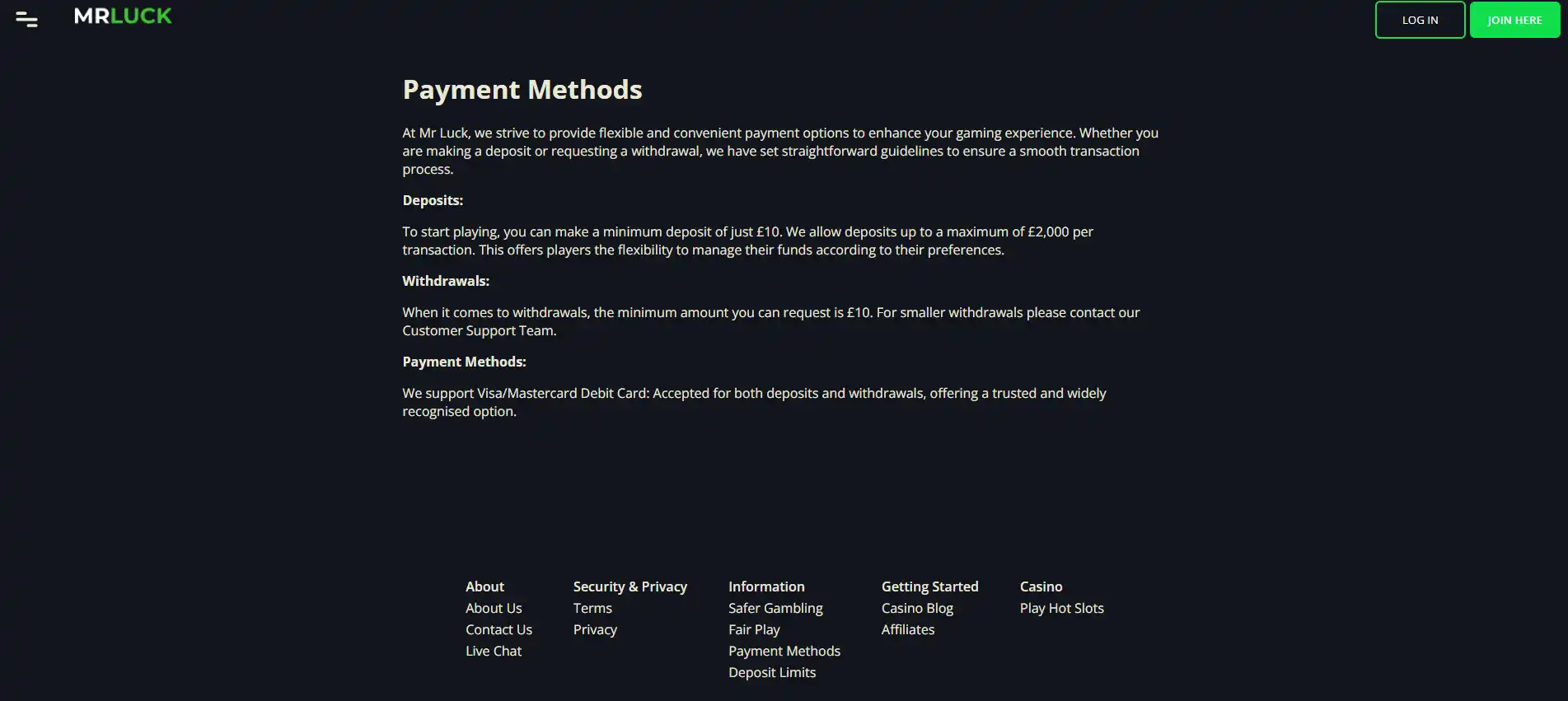
Mr Luck currently lists Apple Pay, PayPal, Skrill, Visa, MasterCard, Maestro, online bank transfer and Neteller among its payment options. Its current Terms set a £10 minimum deposit. For UK players, the main legal distinction is that credit-card gambling is prohibited, including routes that would use an e-wallet to bypass the ban.
Payment methods must belong to the account holder, and Mr Luck can check ownership and source of funds. Availability can be account-dependent, so the live cashier is the strongest final check. For exact cash-out timing, fees and limits, use the withdrawal guide and the figures shown for your account.
Payment methods Mr Luck currently lists
A method list is a starting point rather than a promise that every option will appear for every customer. The account, device, transaction direction and current cashier configuration can affect what is shown. That is why the cashier shows the methods available for an individual deposit, while a general logo list may include options unavailable to that account. The page can identify the listed method categories, but the final choice should come from the options actually offered to the account at the time of the transaction.
The listed methods include cards, bank transfer and selected e-wallets. Visa, Mastercard and Apple Pay are also visibly presented on current casino pages. That gives UK players a mix of card, wallet and bank-based routes, but the list should not be read as a promise that every method will appear for every account, deposit size or withdrawal.
The most useful way to compare the list is by practical type. Visa, MasterCard and Maestro are card rails, but in Great Britain the relevant distinction is debit versus credit funding, because gambling businesses cannot accept credit-card payments for gambling. Apple Pay is a digital payment service that can present an eligible underlying card or account. PayPal, Skrill and Neteller are e-wallets, while online bank transfer connects more directly to a bank account. Mr Luck can refuse a payment method even if it has previously processed that method, so the cashier shown after login is the final account-specific view.
| Method named by Mr Luck | Practical type | What to check before using it |
|---|---|---|
| Visa / MasterCard / Maestro | Card | Use an eligible card in your own name; credit-card gambling is prohibited. |
| Apple Pay | Digital wallet/payment service | Check which underlying funding source is selected and whether it is eligible. |
| PayPal / Skrill / Neteller | E-wallet | The wallet and underlying payment route must comply with the credit-card ban and ownership rules. |
| Online bank transfer | Bank-based | Use an account belonging to you and confirm the current cashier details. |
A logo in the site footer can show that a payment brand is supported somewhere in the product, but the logged-in cashier is more useful for a specific transaction. The cashier can reflect account state, verification, geography and transaction direction, so a brand-level list should not be read as a per-method fee table or a guarantee that every named method supports both deposits and withdrawals.
That distinction matters most with e-wallets. A wallet name tells you the payment service, not necessarily the source that funded it. UK rules are designed to prevent a credit card from being routed through a wallet and then used for gambling. The practical check is therefore two-stage: confirm the wallet is offered to your account, then confirm that the money entering that wallet is from a permitted source.
If your priority is a particular method such as PayPal or Apple Pay, the current cashier identifies whether the method is available immediately before you fund the account. Use the site-wide list as a shortlist, not as a permanent availability guarantee.
Minimum deposit and payment ownership
Ownership is more than a name-matching formality. It connects the gambling account to the card, bank account or wallet used to fund it and gives the operator a basis for later payment verification. A successful deposit therefore does not remove the possibility of a later ownership or source-of-funds check. Using a method in your own name and keeping the registered account details consistent reduces avoidable mismatches if the operator asks for evidence at a later stage.
Mr Luck’s current Terms state a minimum deposit of £10. That is the clearest current deposit threshold in the official terms and is more reliable than an older review table. It does not mean every individual method has identical transaction ranges or that a particular wallet will always accept exactly the same amount, because method-specific controls can still be shown in the cashier.
Ownership is just as important as the amount. Mr Luck says deposits and withdrawals must use valid, legal payment methods that belong to the player. Its Terms specifically prohibit another person’s debit or payment card, another person’s bank account, another person’s e-wallet or digital payment account, business or corporate payment methods, credit cards or credit facilities, and other third-party funds. Where a digital wallet is used, both the wallet and its underlying payment method must belong to the account holder.
This rule connects payment selection with verification. Mr Luck may verify ownership of the method and the source of funds, and it can suspend transactions while checks are completed. That is why borrowing a relative’s card or moving money through somebody else’s wallet is not a harmless shortcut. Even with permission, the method does not satisfy the account-ownership rule described in the Terms.
Make sure the account name, payment-method ownership and funding source all line up before depositing. If they do not, changing method before the transaction is simpler than resolving an ownership mismatch later.
Verification should not be confused with one fixed document checklist. Mr Luck can request information or documents to verify identity, address, payment ownership and source of funds, while the exact evidence depends on the check. The account and verification guide explains how those checks fit into the account journey.
For day-to-day use, the £10 minimum gives a baseline while ownership rules determine which funding route is appropriate. A method is not a better choice merely because it appears fast or familiar if it is not registered to you or cannot satisfy the site’s checks.
Why credit cards are different in Great Britain
UK Gambling Commission licence condition 6.1.2 prohibits licensed gambling businesses from accepting payment for gambling by credit card. The rule covers remote gambling and also extends to payments made through a money service business. In practical terms, an online casino cannot accept a credit card directly, and a digital wallet cannot be used as a route around that prohibition.
This is why a payment list that contains Visa or MasterCard should not be interpreted as evidence that credit cards are accepted. Those networks support more than one kind of card. The relevant question is the funding type behind the card or wallet. A debit card can use the same network branding as a credit card while being treated differently under the rule.
The Gambling Commission also tells operators to ensure that e-wallet providers block credit-card-funded gambling transactions. PayPal and Skrill are examples of wallets discussed in the Commission’s public guidance. This does not make those wallets unavailable; it means the wallet route has to preserve the same restriction that applies to a direct card payment.
Apple Pay needs the same conceptual separation. It is a digital payment layer rather than a new source of money. A card added to a phone remains subject to the relevant gambling-payment rules. Seeing Apple Pay on a casino page therefore does not override the prohibition on credit-funded gambling.
The rule is useful when comparing payment methods because it removes one category from consideration before you get to convenience or speed. For a UK player, the choice should begin with permitted funds in an account or payment method you own. Only then do practical differences such as wallet preference, bank access and the options displayed in the cashier become relevant.
You can read the regulatory wording in the Gambling Commission’s credit-card condition and its e-wallet guidance. These are general Great Britain rules, while the Mr Luck cashier determines which permitted methods are currently available to a particular account.
Deposits versus withdrawals
The direction of the transaction is another reason not to compare methods only by deposit convenience. A method that is easy to use for funding may be handled differently when money is returned, and the Terms say withdrawals are initially directed back to the deposit method subject to verification and internal controls. If cash-out matters to your choice, check both sides before depositing: what the cashier allows for the deposit and what the current withdrawal route says for that same account and method.
A deposit method and a withdrawal method are related, but they are not interchangeable labels. Mr Luck’s Terms say that a withdrawal will in the first instance be made to the payment method used to deposit the funds. They also say withdrawals will only be made to payment methods or accounts belonging to the player and subject to verification requirements. That creates a clear reason to choose a deposit route you can continue to evidence as your own.
The Terms also reserve operational flexibility. Mr Luck says that based on internal risk decisions it may process payments by cheque, and that jackpot amounts over £10,000 may be processed by bank transfer. Those are examples of why a deposit-method list should not be copied into a guaranteed withdrawal-method table.
Current public Terms do not provide one complete method-by-method schedule of withdrawal times, fees, minimums and periodic limits. Check the logged-in cashier and current withdrawal terms for the figures that apply to your account instead of relying on a number copied from an older review.
For withdrawal mechanics, verification dependencies and current account-specific figures, use the dedicated withdrawal guide. Deposit and withdrawal routes are related, but adding money through a method does not guarantee identical timing or conditions when money leaves the account.
Payment continuity matters from deposit to withdrawal. If you deposit through a method that belongs to you, keep the account details current and retain access to that method. If the payment source changes or an ownership question arises, the operator may need additional checks before funds move.
Choosing a Mr Luck deposit method without confusing cards and credit
The best payment method is not a universal winner. It is the permitted method shown to your account that you own, can verify and are comfortable using. Mr Luck currently names card, e-wallet, Apple Pay and bank-transfer options, and its Terms set a £10 minimum deposit. Great Britain rules then remove credit-card funding from the choice.
- Check ownership first: use your own card, bank account or wallet, with your own underlying funding source
- Separate network from funding type: Visa or MasterCard branding does not mean a credit card is permitted
- For wallets, check the source of funds: an e-wallet must not be used to route credit-card money into gambling
- Use the live cashier: the site can vary available methods by account and transaction, so the available methods are those presented to your account in the cashier
- Keep withdrawal compatibility in mind: Mr Luck says withdrawals are initially directed to the method used to deposit, subject to verification and internal controls
- Check timing in the live cashier: deposit and withdrawal speeds can vary by method and account
If you are comparing the payment page with the wider product, the full Mr Luck UK review provides the overall context and the Mr Luck bonus explains the separate promotion rules. If the reason you are choosing a method is how money comes back out, go directly to the withdrawal guide rather than assuming the deposit experience predicts the cash-out experience.
If a method is missing from your cashier, use one of the currently offered alternatives rather than assuming a brand-level list guarantees access.
The simple UK rule is: permitted funds, your own method, current cashier. That approach avoids the two biggest sources of confusion – treating card-network logos as proof of credit-card acceptance and treating a brand-level payment list as a guarantee for every transaction.
A useful final check is therefore method-by-method: confirm that the option is offered to your account, that it belongs to you, that its funding source is permitted and that you understand how the same method is treated when money is withdrawn or returned.
Prepared by the mr Luck Casino editorial staff.